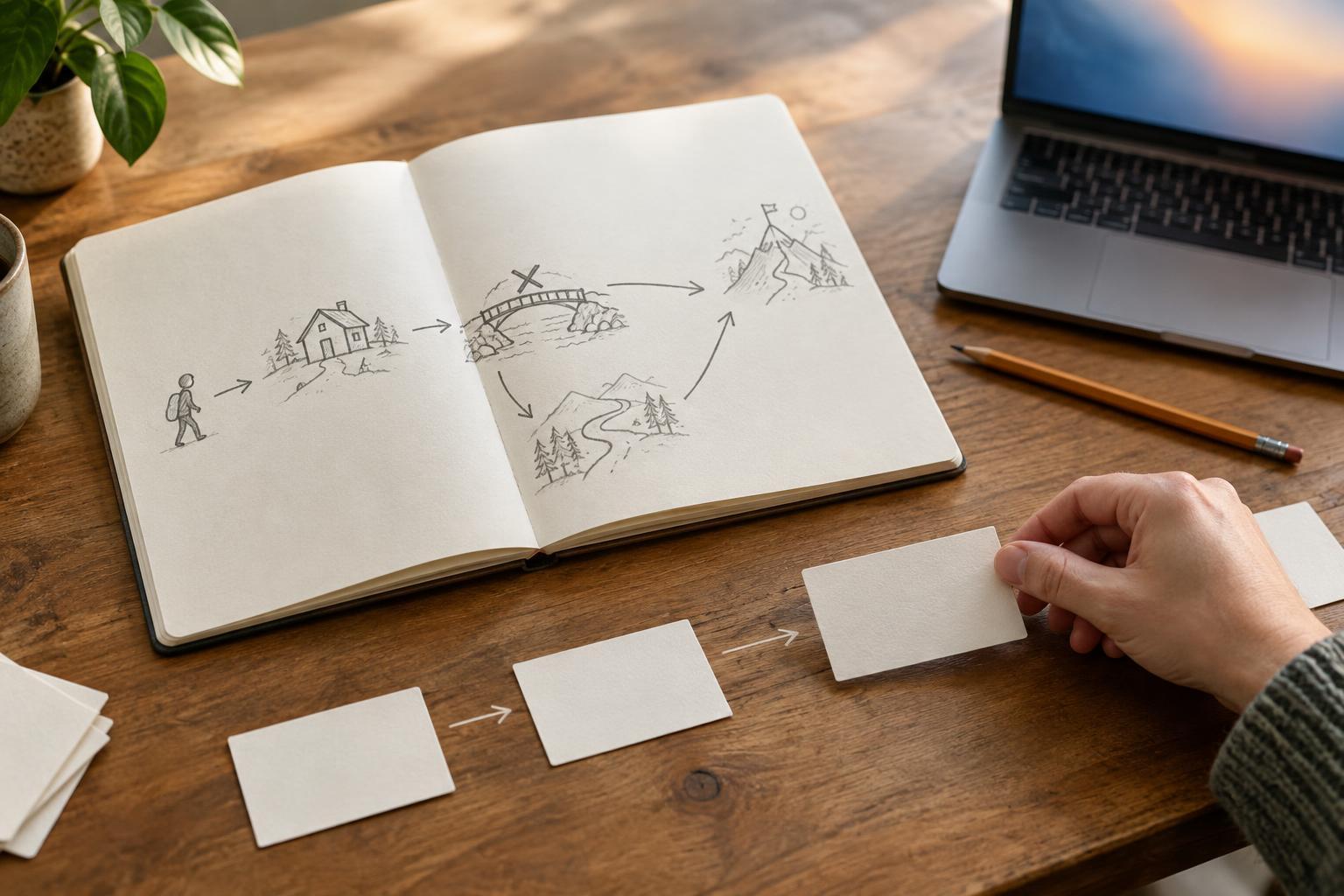
Start with a goal a reader can recognize
An outline does not need to list every scene before you begin writing. It needs a reason for one event to lead to the next. A character goal provides that direction: someone wants something, takes action to get it and discovers that the action has a cost. Goals, obstacles and consequences give you a way to check whether your outline describes a story or simply a sequence of happenings.
Name one concrete goal for your main character. “Find the missing notebook before the exhibition opens” gives you more to work with than “learn to be brave.” The second idea may be an inner need, but it does not yet tell you what the character will do. Pair the visible goal with a private reason it matters. Perhaps the notebook holds a design the character promised to credit to a friend. That reason can turn a straightforward search into a choice about loyalty.
Choose obstacles that demand different choices
An obstacle is more than a delay. It should make the character reconsider a plan, sacrifice something or reveal a priority. If the notebook is behind a locked door, the character needs access. If a colleague has taken it to protect someone else, getting it back now requires a conversation. If the character could recover it by blaming an innocent assistant, the obstacle becomes a moral choice. These problems are related, but they do not ask for the same response.
For a short outline, try three escalating obstacles. The first tests the character’s initial plan. The second makes that plan inadequate. The third forces a decision between the visible goal and something the character values. You do not need to make every obstacle bigger in physical scale; an honest conversation can carry more weight than a chase if it puts the character’s relationships at risk.
Make consequences carry the plot forward
After each major choice, write down what changes. A useful outline entry can take this form: “Because the character does this, this happens; therefore, the next choice is harder.” If the character lies to gain access to the locked room, the immediate consequence might be finding a clue. The later consequence might be losing the trust of the person who could explain it. A consequence can help and hurt at once, which often creates a strong next scene.
Avoid resetting the situation after every obstacle. If a mistake has no lasting effect, the character can keep trying without learning or losing anything. Track a few things that can change: time remaining, access to information, trust between characters and willingness to take a risk. Near the end, bring at least one earlier consequence back into play. The final decision will feel more connected to the story if it grows from choices the character already made.
Turn the chain into a working outline
Write a one-sentence opening situation, then list the major turns in order. For each turn, note the character’s immediate goal, the obstacle, their choice and the resulting change. End with a decision that answers the story’s central question. In the notebook example, the question may shift from “Can they retrieve it?” to “Will they tell the truth about who made the design?” That shift gives the external search an emotional payoff.
Keep the outline brief enough to revise. If two turns produce the same kind of problem and the same response, combine them or change one. If the ending depends on information no one could have known, plant an earlier clue. If the character reaches the ending without making a meaningful choice, look for a moment where they can act rather than simply receive an answer. The outline is a tool for noticing these gaps, not a contract you must follow while drafting.
Use AI to explore, then select deliberately
An AI assistant can be useful for generating alternatives when your outline feels predictable. Give it your premise, the character’s goal and the consequences already established. Then ask a narrow question, such as: “Suggest five obstacles that force different choices. For each, explain what changes afterward. Do not resolve the story.” Comparing options is often more useful than asking for a complete plot, because you retain control over what belongs in your story.
Treat the suggestions as possibilities, not judgments about what will make a story good. An AI-generated turn may contradict a character’s motivation, repeat an earlier beat or solve a problem too easily. Check each idea against your outline: Does it follow from what came before? Does the choice reveal character? Does its consequence affect what comes next? Keep the turns that sharpen those connections, revise the ones with potential and discard the rest.